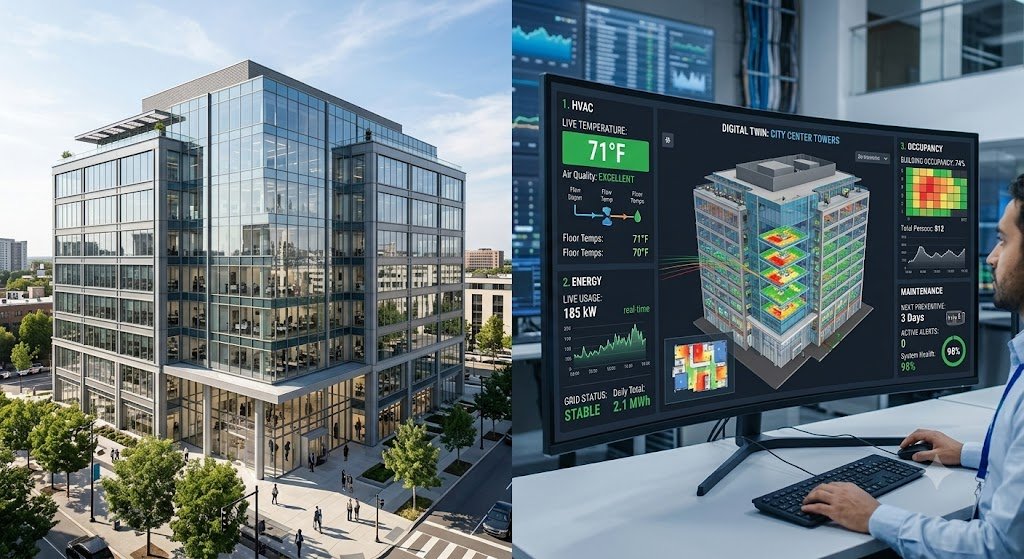
Digital Twin Facility Management: Benefits, Use Cases, and Best Practices
Introduction
Digital twin facility management uses a virtual replica of a physical building to monitor, analyze, and optimize operations in real time. By connecting data from IoT sensors, Building Management Systems (BMS), and maintenance software, facility managers gain complete visibility into assets, energy usage, occupancy, and equipment performance. Whether managing a hospital, office, university, or industrial facility, digital twins improve decision-making, reduce operating costs, and support predictive maintenance, making them one of the most valuable technologies in modern facilities management.
What Is Digital Twin Facility Management?
A digital twin is a dynamic, virtual representation of a physical building or facility that continuously updates using real-time operational data.
Unlike static building models or traditional CAD drawings, a digital twin reflects what’s happening inside a building at any given moment. It combines information from connected devices, sensors, software platforms, and historical records into one intelligent system.
In digital twin facility management, the digital model mirrors the performance of the real facility, allowing managers to monitor systems, predict failures, and optimize operations without relying solely on manual inspections.
A digital twin typically integrates:
- Building Information Modeling (BIM)
- IoT sensors
- Building Management Systems (BMS)
- Computerized Maintenance Management Systems (CMMS)
- Energy management software
- HVAC controls
- Occupancy sensors
- Security systems
Together, these technologies create a centralized platform for smarter facility operations.
How Digital Twin Technology Works
A digital twin continuously receives data from connected building systems.
The process generally follows these steps:
- Sensors collect operational data.
- Data is transmitted to cloud-based software.
- The digital twin updates automatically.
- Analytics identify trends and anomalies.
- Facility managers receive actionable insights.
This continuous data flow enables real-time monitoring and informed decision-making.
Why Digital Twins Are Transforming Facilities Management
Traditional facility management often relies on scheduled inspections and reactive maintenance.
Digital twins shift this approach by providing live operational intelligence.
Benefits include:
- Faster issue detection
- Reduced downtime
- Improved asset visibility
- Better maintenance planning
- Higher operational efficiency
- Improved occupant comfort
- Lower operating costs
Instead of reacting to failures, organizations can prevent many problems before they occur.
Key Benefits of Digital Twin Facility Management
Predictive Maintenance
Predictive maintenance is one of the biggest advantages of digital twins.
Rather than replacing equipment on fixed schedules, facility managers monitor actual performance.
The system detects:
- Temperature abnormalities
- Vibration changes
- Pressure variations
- Power consumption spikes
- Equipment degradation
Maintenance teams receive alerts before failures occur, reducing emergency repairs.
Energy Optimization
Buildings account for a significant portion of global energy consumption.
Digital twins monitor:
- HVAC performance
- Lighting usage
- Water consumption
- Electricity demand
- Peak energy loads
Managers can identify inefficiencies and adjust operations to lower utility costs while supporting sustainability goals.
Improved Asset Management
Every building contains thousands of assets.
Digital twins maintain accurate records of:
- Equipment location
- Maintenance history
- Warranty information
- Service schedules
- Asset condition
This improves lifecycle management and simplifies maintenance planning.
Enhanced Occupant Experience
Comfort directly affects productivity and satisfaction.
Digital twins help optimize:
- Indoor temperature
- Air quality
- Lighting
- Space utilization
- Noise levels
Real-time adjustments create healthier and more comfortable environments.
Digital Twin for Facilities Management Across Different Industries
The flexibility of digital twin for facilities management makes it valuable across numerous sectors.
Commercial Office Buildings
Office managers use digital twins to:
- Monitor occupancy
- Improve energy efficiency
- Optimize meeting spaces
- Reduce maintenance costs
- Enhance employee comfort
Hybrid workplaces especially benefit from occupancy analytics.
Healthcare Facilities
Hospitals depend on reliable building systems.
Digital twins help monitor:
- HVAC systems
- Medical gas infrastructure
- Critical equipment
- Infection control environments
- Emergency power systems
Continuous monitoring supports patient safety and regulatory compliance.
Universities and Campuses
Educational institutions often manage multiple buildings.
Digital twins simplify:
- Space management
- Classroom utilization
- Energy tracking
- Preventive maintenance
- Infrastructure planning
Administrators gain centralized visibility across entire campuses.
Manufacturing Facilities
Factories rely on uninterrupted operations.
Digital twins improve:
- Equipment uptime
- Production support systems
- Environmental monitoring
- Utility management
- Worker safety
Predictive analytics minimize costly production interruptions.
Airports and Transportation Hubs
Large transportation facilities require continuous monitoring.
Digital twins support:
- Passenger flow analysis
- HVAC optimization
- Security integration
- Escalator monitoring
- Terminal maintenance
These insights improve operational efficiency while enhancing traveler experiences.
if you want more information, click here.
Core Technologies Behind Digital Twin Solutions
Successful digital twin implementation depends on multiple technologies working together.
Internet of Things (IoT)
IoT devices collect live information from building systems.
Common sensors monitor:
- Temperature
- Humidity
- Occupancy
- Motion
- Air quality
- Energy usage
Without IoT connectivity, digital twins cannot provide real-time insights.
Building Information Modeling (BIM)
BIM provides the visual foundation for many digital twins.
It includes:
- Architectural layouts
- Structural information
- Mechanical systems
- Electrical infrastructure
- Plumbing systems
When combined with live sensor data, BIM becomes an intelligent operational platform.
Artificial Intelligence
AI analyzes large amounts of building data.
It helps identify:
- Equipment failures
- Energy waste
- Occupancy trends
- Maintenance priorities
- Performance anomalies
Machine learning continuously improves recommendations over time.
Cloud Computing
Cloud platforms store and process large volumes of operational data.
Cloud-based systems offer:
- Remote access
- Scalable storage
- Real-time collaboration
- Automatic updates
- Improved disaster recovery
Best Digital Twin Facility Management Features to Look For
Choosing the best digital twin facility management platform requires evaluating several capabilities.
Look for solutions that include:
- Real-time dashboards
- Predictive maintenance analytics
- BIM integration
- IoT compatibility
- Asset lifecycle management
- Energy monitoring
- Mobile accessibility
- CMMS integration
- Security controls
- Reporting and analytics
A scalable platform allows organizations to expand functionality as operational needs evolve.
Common Challenges During Implementation
Although digital twins provide significant value, implementation requires planning.
Organizations commonly encounter:
- High initial investment
- Legacy system integration
- Data quality issues
- Employee training
- Cybersecurity concerns
- Sensor deployment costs
A phased implementation strategy often delivers better long-term results.
Best Practices for Successful Digital Twin Adoption
Organizations achieve stronger results by following proven implementation practices.
Define Clear Objectives
Identify measurable goals before deployment.
Examples include:
- Lower maintenance costs
- Reduce energy usage
- Improve equipment reliability
- Increase occupant satisfaction
Clear objectives guide technology decisions.
Start with High-Value Assets
Instead of modeling every system immediately, begin with critical assets such as:
- HVAC equipment
- Electrical systems
- Chillers
- Boilers
- Elevators
Expanding gradually reduces complexity.
Ensure Data Accuracy
Digital twins depend on reliable information.
Regularly verify:
- Sensor calibration
- Asset inventories
- Equipment records
- Building layouts
- Maintenance history
Accurate data leads to better decisions.
Train Facility Teams
Technology succeeds when people understand how to use it.
Provide training on:
- Dashboard navigation
- Alert management
- Predictive maintenance
- Reporting tools
- Data interpretation
Well-trained teams maximize return on investment.
Future Trends in Digital Twin Facility Management
Digital twin technology continues to evolve rapidly.
Emerging trends include:
- AI-powered autonomous buildings
- Digital twins integrated with smart cities
- Advanced sustainability analytics
- Carbon footprint optimization
- Real-time space optimization
- Augmented reality maintenance support
- Digital twin simulations for emergency planning
As buildings become smarter, digital twins will become standard tools for facility operations.
Measuring Return on Investment
Organizations often measure success using key performance indicators such as:
- Reduced maintenance costs
- Lower energy consumption
- Improved equipment uptime
- Faster repair response times
- Longer asset lifespan
- Better occupant satisfaction
- Reduced operational risk
Many organizations begin seeing measurable improvements within the first year after implementation, particularly when predictive maintenance and energy optimization are prioritized.
Frequently Asked Questions
1. What is digital twin facility management?
Digital twin facility management involves creating a real-time virtual representation of a building using IoT sensors, BIM, and operational data. It helps facility managers monitor assets, improve maintenance, optimize energy usage, and make data-driven decisions.
2. How does a digital twin improve facility maintenance?
Digital twins continuously monitor equipment performance and identify early warning signs of failure. This enables predictive maintenance, reducing unexpected breakdowns, minimizing downtime, and extending the lifespan of building assets.
3. What industries benefit from digital twin for facilities management?
Many industries benefit, including commercial real estate, healthcare, education, manufacturing, airports, government facilities, hospitality, and data centers. Any organization managing complex buildings can improve operational efficiency through digital twin technology.
4. What features should the best digital twin facility management platform include?
The best digital twin facility management solution should provide real-time monitoring, predictive analytics, BIM integration, IoT connectivity, energy management, asset tracking, reporting tools, mobile access, and seamless integration with existing maintenance systems.
5. Is digital twin technology suitable for small facilities?
Yes. While enterprise organizations often lead adoption, smaller facilities can also benefit. Cloud-based solutions and scalable platforms allow organizations to implement digital twins gradually, starting with critical assets before expanding across the entire facility.
Conclusion
Digital twin facility management is reshaping how organizations operate, maintain, and optimize buildings. By combining real-time data, intelligent analytics, IoT connectivity, and predictive maintenance, digital twins enable facility managers to make faster, smarter decisions while reducing costs and improving building performance. Whether you’re exploring a digital twin for facilities management for a single property or evaluating the best digital twin facility management platform for a large portfolio, investing in this technology can deliver long-term operational, financial, and sustainability benefits. As digital transformation accelerates, adopting digital twin solutions today positions facilities for greater efficiency, resilience, and success in the years ahead.