Retail AI Vision Automation: Transforming the Future of Smart Retail
Featured Image Suggestion
Introduction
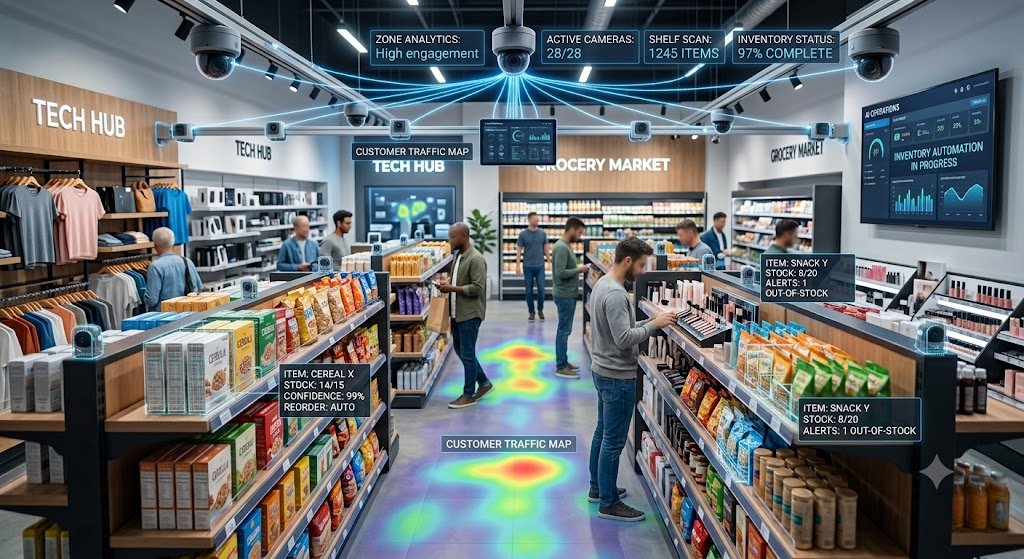
Retail AI vision automation uses artificial intelligence, computer vision, and smart cameras to automate everyday retail operations. By analyzing images and video in real time, these systems can monitor inventory, detect empty shelves, reduce theft, improve customer experiences, and provide valuable business insights. As retailers face increasing competition, labor shortages, and higher customer expectations, AI vision automation has become a powerful tool for improving efficiency, reducing costs, and making data-driven decisions across physical stores.
What Is Retail AI Vision Automation?
Retail AI vision automation combines computer vision, machine learning, and intelligent video analytics to help retailers understand what’s happening inside their stores without relying solely on manual observation.
Instead of simply recording video, AI-powered cameras analyze visual information in real time to identify products, customers, shopping patterns, and operational issues.
These systems can automatically recognize:
- Products on shelves
- Customer movement
- Shopping behavior
- Inventory levels
- Checkout activity
- Safety hazards
- Employee workflows
This enables retailers to make faster and more informed decisions.
How Retail AI Vision Automation Works
The technology relies on several integrated components working together.
Smart Cameras
High-definition cameras capture images and video throughout the store.
These cameras monitor areas such as:
- Store entrances
- Product aisles
- Checkout lanes
- Stockrooms
- Display shelves
Modern cameras can operate continuously while maintaining high image quality.
Computer Vision
Computer vision software processes the captured images.
Using advanced algorithms, the system identifies:
- Individual products
- Shelf conditions
- Customer interactions
- Shopping carts
- Store traffic
- Objects and people
Unlike traditional surveillance, computer vision understands what appears in each image.
Artificial Intelligence
Machine learning models continuously improve detection accuracy.
AI can recognize patterns and automatically generate alerts for situations such as:
- Empty shelves
- Misplaced products
- Long checkout lines
- Suspicious activity
- Stock shortages
As more data becomes available, the system becomes increasingly accurate.
Key Benefits of Retail AI Vision Automation
Retailers adopt AI vision technology for many reasons.
Major benefits include:
- Improved inventory accuracy
- Faster shelf replenishment
- Reduced labor costs
- Better customer experiences
- Enhanced store security
- Increased sales opportunities
- More efficient operations
- Data-driven decision-making
These advantages contribute to stronger financial performance and customer satisfaction.
Inventory Management
Inventory management is one of the most valuable applications of AI vision automation.
Real-Time Shelf Monitoring
AI-powered cameras constantly monitor store shelves.
The system can detect:
- Empty shelves
- Low inventory
- Incorrect product placement
- Pricing errors
- Missing promotional displays
Store associates receive alerts before customers encounter out-of-stock items.
Automated Inventory Audits
Traditional inventory counts require significant time and labor.
AI vision systems automate much of this process by continuously tracking product availability.
Benefits include:
- Greater inventory accuracy
- Reduced manual counting
- Faster stock replenishment
- Lower operational costs
Retailers gain real-time visibility into inventory performance.
Improving Customer Experience
Customer satisfaction remains a top priority for retailers.
AI vision automation helps improve the shopping experience in several ways.
Shorter Checkout Wait Times
The system monitors checkout activity and identifies growing queues.
Managers receive alerts when:
- Checkout lines become too long
- Additional cashiers are needed
- Self-checkout stations require assistance
This reduces waiting time and improves customer satisfaction.
if you want to know, Information Technology Risk Management Policy Guide ,click here.
Personalized Store Layouts
Heat maps generated by AI reveal how customers move throughout the store.
Retailers use this information to:
- Optimize product placement
- Improve store layouts
- Increase product visibility
- Enhance promotional displays
Better layouts often increase sales and improve shopping convenience.
Loss Prevention and Security
Retail theft continues to challenge retailers worldwide.
AI vision automation strengthens security by identifying unusual behavior.
Common capabilities include:
- Detecting suspicious activity
- Monitoring restricted areas
- Identifying abandoned objects
- Recognizing unauthorized access
- Alerting security personnel
Unlike traditional surveillance, AI systems actively analyze events instead of simply recording them.
Employee Productivity
AI automation also supports retail employees.
The technology reduces repetitive tasks such as:
- Shelf inspections
- Inventory verification
- Product location checks
- Manual reporting
Employees can spend more time assisting customers instead of performing routine operational work.
Pricing and Promotional Compliance
Retailers invest heavily in promotions.
AI vision systems verify whether promotional displays are correctly implemented.
The technology can identify:
- Missing promotional signs
- Incorrect pricing labels
- Improper product placement
- Expired promotions
Maintaining promotional accuracy improves customer trust and marketing effectiveness.
Retail Analytics
One of AI vision’s greatest strengths is its ability to generate valuable business insights.
Retail analytics may include:
- Customer traffic patterns
- Peak shopping hours
- Product engagement
- Conversion rates
- Dwell time
- Store performance metrics
These insights support better operational and marketing decisions.
Popular Use Cases
Retail AI vision automation serves businesses of many sizes.
Common applications include:
- Grocery stores
- Supermarkets
- Convenience stores
- Department stores
- Electronics retailers
- Pharmacies
- Fashion retailers
- Home improvement stores
Each business can customize the technology according to its operational needs.
Integration With Other Retail Technologies
AI vision automation delivers even greater value when integrated with existing systems.
Examples include:
- Point-of-sale (POS) systems
- Inventory management software
- Enterprise resource planning (ERP)
- Warehouse management systems
- Customer relationship management (CRM)
- Electronic shelf labels
Integrated platforms provide a more complete view of store operations.
Challenges of Retail AI Vision Automation
Despite its advantages, retailers should consider several implementation challenges.
These include:
- Initial investment costs
- Data privacy requirements
- Camera installation
- Staff training
- System integration
- Ongoing maintenance
Proper planning helps organizations maximize their return on investment.
Privacy and Ethical Considerations
Because AI vision systems analyze customer activity, retailers must prioritize privacy.
Best practices include:
- Following applicable privacy regulations
- Informing customers about video monitoring
- Limiting unnecessary data collection
- Securing stored information
- Using anonymized analytics whenever possible
Transparent data practices help maintain consumer trust.
Future Trends in Retail AI Vision Automation
The technology continues evolving rapidly.
Emerging trends include:
Autonomous Stores
Cashier-less shopping experiences continue gaining popularity.
AI vision systems automatically recognize products selected by customers and process payments with minimal manual interaction.
Generative AI Integration
Retailers are beginning to combine computer vision with generative AI to improve reporting, forecasting, and operational recommendations.
Managers may receive automated summaries explaining store performance and suggesting improvements.
Predictive Analytics
Future systems will increasingly predict:
- Inventory shortages
- Customer demand
- Staffing requirements
- Equipment failures
- Shopping trends
Predictive insights help retailers make proactive decisions.
Best Practices for Successful Implementation
Organizations can improve results by following proven implementation strategies.
Recommended steps include:
- Clearly define business objectives.
- Start with pilot projects.
- Train employees thoroughly.
- Select scalable AI platforms.
- Monitor performance regularly.
- Protect customer data.
- Continuously update AI models.
- Measure return on investment.
A phased implementation often reduces risk while maximizing long-term benefits.
Industries Benefiting Beyond Retail
Although designed for retail, AI vision automation also supports:
- Warehousing
- Logistics
- Manufacturing
- Hospitality
- Healthcare
- Airports
- Transportation
The underlying computer vision technology has applications across numerous industries.
Frequently Asked Questions
1. What is retail AI vision automation?
Retail AI vision automation uses artificial intelligence, computer vision, and smart cameras to automate inventory monitoring, customer analytics, security, and operational tasks within retail stores.
2. How does AI vision improve inventory management?
It continuously monitors shelves, detects out-of-stock products, identifies misplaced items, and alerts employees when replenishment is needed, reducing manual inventory checks.
3. Is retail AI vision automation expensive?
Implementation costs vary depending on store size, camera infrastructure, and software requirements. However, many retailers achieve long-term savings through improved efficiency and reduced losses.
4. Can AI vision reduce retail theft?
Yes. AI systems can identify suspicious behaviors, monitor restricted areas, detect unusual activity, and notify security personnel in real time, strengthening loss prevention efforts.
5. Does AI vision automation replace retail employees?
No. In most cases, AI automates repetitive operational tasks, allowing employees to focus on customer service, sales, and higher-value responsibilities rather than replacing them entirely.
Conclusion
Retail AI vision automation is transforming modern retail by combining artificial intelligence, computer vision, and real-time analytics to improve inventory management, customer experiences, security, and operational efficiency. As retailers continue embracing digital transformation, AI-powered vision systems will play an increasingly important role in helping businesses reduce costs, optimize store performance, and make smarter decisions. Whether you’re managing a single retail location or a nationwide chain, investing in AI vision automation can position your business for greater efficiency, stronger customer satisfaction, and long-term competitive success.